
Showing posts with label nature. Show all posts
Showing posts with label nature. Show all posts
Friday, June 13, 2014
Clouds and the infinite imagination : Pareidolia
A deeper look into the clouds reveals an infinite set of imaginations but finally they are all just clouds. The phenomenon is termed as pareidolia where we perceive significant patterns or images where nothing actually exists.

Humans : The most dangerous animal !!!
Humans are the most dangerous animal existing on this planet. These lines were impressed upon me by an old woman in a small temple city called Uluvi located in the dense forest region of western ghats. The temple town is also famous for caves which is sparsely explored and by remaining in the midst of the dense forests has escaped the prying eyes of many tourists.
Uluvi Pics
A visit to cave in the wee hours
The first time I visited the caves, I had accompanied by a guide to explore the caves. But this time one of the shopkeeper advised us that we can see it by our own because of better direction boards put up now. So, we started out early and went downhill to the place near the caves. The caves and the absence of other people made us feel a bit insecure. We were afraid of entering into the caves for the fear of animals taking shelter there as it was drizzling all the way. We sat in front of the caves for sometime and got back.
The query of the animals
An old lady who is an inhabitant in that city brought us the tea when we returned back to our accommodation. I started inquiring to her about the caves and the presence of animals around there and how to deal with them in case of an attack. She replied that it was very rare that animals came into the way of humans near that caves and remarked that it is rather "humans are more dangerous animals". On being asked about how to deal with them, she resorted that unlike humans, other animals usually won't interfere in the way of humans and they try to be away from the human beings most of the time. It is; we as humans try to poke them and invite the trouble most of the times. These words made me to think about the older generations which lived in close proximity with these wildlife and concluded that there is lot of truth in the words of that old lady. The humans are indeed "the most dangerous animal" as he has interfered the most in the living of other animals and in many instances completely endangering the ecosystem of the wildlife.
Uluvi Pics
A visit to cave in the wee hours
The first time I visited the caves, I had accompanied by a guide to explore the caves. But this time one of the shopkeeper advised us that we can see it by our own because of better direction boards put up now. So, we started out early and went downhill to the place near the caves. The caves and the absence of other people made us feel a bit insecure. We were afraid of entering into the caves for the fear of animals taking shelter there as it was drizzling all the way. We sat in front of the caves for sometime and got back.
The query of the animals
An old lady who is an inhabitant in that city brought us the tea when we returned back to our accommodation. I started inquiring to her about the caves and the presence of animals around there and how to deal with them in case of an attack. She replied that it was very rare that animals came into the way of humans near that caves and remarked that it is rather "humans are more dangerous animals". On being asked about how to deal with them, she resorted that unlike humans, other animals usually won't interfere in the way of humans and they try to be away from the human beings most of the time. It is; we as humans try to poke them and invite the trouble most of the times. These words made me to think about the older generations which lived in close proximity with these wildlife and concluded that there is lot of truth in the words of that old lady. The humans are indeed "the most dangerous animal" as he has interfered the most in the living of other animals and in many instances completely endangering the ecosystem of the wildlife.
Friday, October 18, 2013
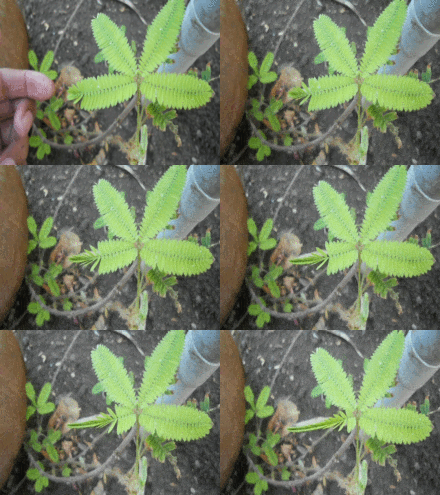
Touch me not Mimosa !!!
Mimosa
pudica L or touch-me-not plant has an unique phenomenon in its ability to close the leaves even for the
slightest touch stimuli. Touch-me-not plant is also called by the names
humble plant, shameful plant, sensitive plant etc. Mimosa pudica belongs
to legume family. Mimosa is a short, prickly, perennial herb with
branches growing close to ground. The generic name Mimosa is derived
from the Greek in which "mimos" means to "mimic". Latin word "pudica", means
"bashful or shrinking to contact".

Nyctinastic & seismonastic movement
During night leaves
of Mimosa close up and reopen in the morning. This is called as
nyctinastic movement or sleep movement. Leaves of Mimosa fold inward and
droop for the stimuli such as touching, warming, blowing, or shaking.
This type of movement is called as seismonastic movement.
The mechanism
Turgor pressure is exerted by the water onto cell wall, vacuoles and other cell contents of the plant. The stimulus such as touch triggers the release of chemicals including potassium ions from certain areas of the stem. As a result water from the vacuoles of the cell comes out and turgor pressure is dropped. This result in collapsing of cells and leaflets are closed. This movement to touch stimulus appears to be the defense mechanism against herbivores. It’s interesting to note that Indian scientist Jagadish Chandra Bose observed this response in plant and demonstrated the fact that plants also can feel pain.
Monday, July 1, 2013
The debacle after Uttarakhand's floods
International charity ActionAid's claim "construction of hydroelectric dams and mining projects over the last decade in the state's many valleys has threatened its fragile ecosystem."
The flash floods could have been taken care of by the nature if the soil had that capacity. The diversion of rivers, digging of tunnels might have caused irreparable damage to soil strength.
The Uttarkhand's response to disaster is a disaster...
Banning the building along the river banks!
The rivers may change direction in extreme conditions. The flash floods definitely encroaches the non-bank's building. Instead of addressing the crux of the issue, this is just a symptomatic knee jerk reaction. Not even a mention about big projects affecting the ecosystem. The power hungry nation is eager to take a hit on environment in a blind pursuit of development.
The flash floods could have been taken care of by the nature if the soil had that capacity. The diversion of rivers, digging of tunnels might have caused irreparable damage to soil strength.
The Uttarkhand's response to disaster is a disaster...
Banning the building along the river banks!
The rivers may change direction in extreme conditions. The flash floods definitely encroaches the non-bank's building. Instead of addressing the crux of the issue, this is just a symptomatic knee jerk reaction. Not even a mention about big projects affecting the ecosystem. The power hungry nation is eager to take a hit on environment in a blind pursuit of development.
Tuesday, December 11, 2012
International Mountain Day

― Barry Finlay‘s words are pills of inspiration for everyone who love to face challenges. Mountains are the areas with steep slopes that are raised high above surroundings, in a limited area. Mountains are higher and steeper than hills. Mountains are formed by geological forces like pressure and heat producing changes and movements in the earth’s crust. Volcanism, erosion, and uplift in the earth's crust have given rise to mountains –the unique landmass on the earth.
Mountains have summit
or the top of mountain, the slope or the side of the mountains, and steep
valleys in between young mountains. Mountains are also present under the
surface of sea. Mountains do occur in oceans and some islands are the peaks of
the mountains seen outside the water. Some mountain areas show frozen water
bodies called glaciers.
Long chains of
mountains form Mountain ranges. Ranges are usually 1,000 or more miles long. The
Himalayas are the world's overall tallest mountains. The Andes, the longest
mountain range in the world. Mountains exhibit rapid variation in climate,
vegetation, altitude, soil over very short distances. In general mountains are
higher than 600 meters. Around 12% of world population lives in mountains. Mountains
are home for various ethnic communities.
Mountains are the major
sources of freshwater. They harbor rich biodiversity. Maple, conifers,
chestnut, mosses, ferns and climbers are found more commonly on mountains.
Animals found in mountain areas are well adapted for extreme climatic
conditions. Timberline is where growth of trees no longer occurs on a mountain.
Different
types of mountains
Fold Mountains
are formed by collision of the plates of crust (eg: Himalayan Mountains in
Asia)
Fault-block
Mountains are formed when
cracks
in the earth's crust force some materials or blocks of rock to rise high or
fall low. (eg: the Harz Mountains in Germany)
Dome Mountains are
formed as a result of a great amount of melted rock (magma) pushing its way up
under the earth crust. Here earth’s crust doesn’t erupt. At some point of time,
the magma cools down and forms hardened rock. (eg: Half Dome in California’s
Sierra Nevada)
Volcanic Mountains
are formed when molten rock (magma) deep within the earth, erupted, and piled upon
the surface. ( eg: Mount Pinatubo in the Philippines)
Plateau Mountains
are formed by the erosion of large flat areas. (Eg: Adirondack Mountains in the
United States)
Mountains are the cradles of richest biodiversity on the earth, Mountains
play crucial role in our life. Environmental degradation, exploitative
mining, hydropower projects, armed conflict and so many other problems have
encircled mountains. Today while celebrating international mountain day, let us
hope the mountain biome will be protected and guarded as the treasure for
future generation.
"It's always further than it looks. It's always taller
than it looks. And it's always harder than it looks."
— The 3 rules of mountaineering.
Tuesday, November 27, 2012
Venus Flytrap


Carnivorous plants
are those, which obtain the nutrients by trapping smaller animals like insects and
other arthropods. Venus Flytrap (Dionaea
muscipula) is one such plant. It feeds on beetles, spiders and
arthropods. Venus Flytrap is found in nitrogen- and phosphorus poor
environments, its native being boggy
areas of North and South Carolina.
Venus Flytrap
has narrow, green leaves that extend from the base of
the plant. A pair of reddish, kidney shaped lobes is hinged on the either side
of a mid-rib at the terminal part of the leaf. These lobes form the trap. On
the upper portion of, each side of the trap anthocyanin pigments are present
and that gives red or purple color to this surface .Most probably this color
attracts the insects towards the plant. Outer margin of the lobe contains
spikes and nectar glands beneath the spikes. Few isolated hairs can be seen on
the lobes.
Insect crawling on the leaf, when contacts
hair, triggers the trap to snap shut. It is interesting to note that trapping mechanism
can distinguish between living prey and other stimuli like falling rain drops. If
two trigger hairs are touched by insect
or one trigger hair is touched twice within a short period of time(say 20
seconds) the trap is closed within 10th of a second. Inside the trap
the prey struggles and repeatedly touches the trigger hair. This in turn
tightens the trap. If the prey is too small it can escape from the teeth of the
trap. It is beneficial to plant because the energy spent to digest small prey
is more than the energy obtained from it. Within few minutes the trap will become
air tight and digestive fluid inside dissolves the soft part of the insect so
that nutrients are absorbed.
The
exact mechanism of the trapping is not known. It is believed to be due to the
complex interaction of some biochemical and elastic processes. It takes five to
twelve days for the digestion to complete and then the trap reopens and the
remaining exoskeleton is removed either by rain or by the wind. Mature plants
produce flowers on the long stalks and then tiny seeds are formed.
Carnivora is a patented extract of Venus flytrap
plant, is claimed to have immune stimulant and
anticancer properties. Botanists studied Venus Flytrap in the 17th and 18th
centuries. They found a parallel between the trap of the plant and certain
aspects of female anatomy and behavior. So it is said that they named the plant
after Venus, the pagan goddess of love and money.
Venus fly traps have evolved into carnivorous
plant due to lack of nutrients in the soil that required for plant growth. Nitrogen
from trapped prey is used by the plant for the protein formation as it grows in
nitrogen deficient soil. Venus Flytrap
a wonder of the nature and serves as the
example for the adaptation of the life to the toughest environment.
Subscribe to:
Posts (Atom)


