Pages

Showing posts with label science. Show all posts

Friday, October 18, 2013

Touch me not Mimosa !!!

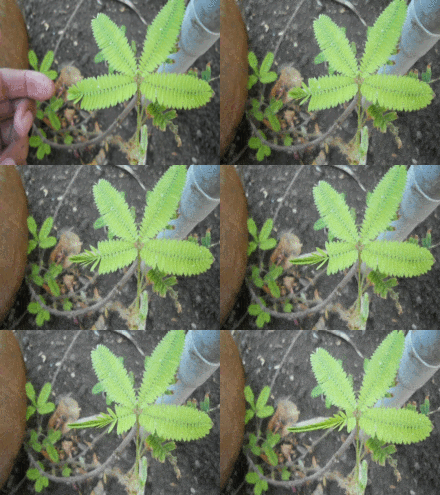
Mimosa pudica L or touch-me-not plant has an unique phenomenon in its ability to close the leaves even for the slightest touch stimuli. Touch-me-not plant is also called by the names humble plant, shameful plant, sensitive plant etc. Mimosa pudica belongs to legume family. Mimosa is a short, prickly, perennial herb with branches growing close to ground. The generic name Mimosa is derived from the Greek in which "mimos" means to "mimic". Latin word "pudica", means "bashful or shrinking to contact".


Nyctinastic & seismonastic movement
During night leaves of Mimosa close up and reopen in the morning. This is called as nyctinastic movement or sleep movement. Leaves of Mimosa fold inward and droop for the stimuli such as touching, warming, blowing, or shaking. This type of movement is called as seismonastic movement.                               

The mechanism 
Turgor pressure is exerted by the water onto cell wall, vacuoles and other cell contents of the plant. The stimulus such as touch triggers the release of chemicals including potassium ions from certain areas of the stem. As a result water from the vacuoles of the cell comes out and turgor pressure is dropped. This result in collapsing of cells and leaflets are closed. This movement to touch stimulus appears to be the defense mechanism against herbivores. It’s interesting to note that Indian scientist Jagadish Chandra Bose observed this response in plant and demonstrated the fact that plants also can feel pain.   

Sunday, August 25, 2013

Why tears is common for extremes...


Pleasure and pain are part and parcel of our life. Blending of the emotions like happiness, sad, anger glorifies the life.
                Tears have the primary function of cleaning and lubricating eyes. Tears shed down from eyes for different reasons. It may be reflex reaction like cutting onions or dust in eye; it may be during extreme emotions like grief, sadness or may be due to some underlying pathology.
                It is a well-known fact that we cry when we laugh hard...But why??? Most probable explanation is laughing hard creates pressure on nasolacrimal ducts. So tears cannot flow into nasolacrimal duct as they usually do in normal conditions. At the same time eyelids also close. Hence tears cannot flow into eyelid. So tears come out.  On the other hand it may be a homeostatic mechanism that brings body to a normal state after extreme excitement accompanying the laugh. Researcher William H. Frey, II found that emotional tears are rich in protein based hormones prolactin, adrenocorticotropic hormone, and leucine enkephalin.  Dr. Frey had stated that crying releases chemicals that the body produced in response to stress. Laughter and tears are helpful to tackle stress as both of them counteract the effects of cortisol and adrenaline.
                Always remember the fact - a good cry during extreme pain or pleasure lightens your heart and bring peace to your mind !!!

Thursday, June 27, 2013

Chameleons & Changing colors


Chameleons are lizards belonging to family called Chamaeleonidae. When we think of Chameleons, the first thing that strikes to mind is their ability to change colors.

Change of colour to camouflage!!! Not really!!!

It’s a popular belief that Chameleons change the color to blend with nature and to hide from predators. But camouflage is not the primary reason for change in skin color. Changing skin color in Chameleons is associated with various factors such as their reactions to temperature, light, mood, aggression, health, mating behavior.

Each chameleon species has its own color range. In general calm chameleons show green color. They exhibit darker colors like bright yellow to show their anger. It also serves the purpose of threatening others. Male chameleons when want to mate, show lighter, multicolored patterns.  Female chameleons show black with orange strips or dark brown color when they are carrying eggs. Chameleons become darker to absorb the heat effectively and show lighter grey color to reflect the light. A sick chameleon appears pale due to lack of sufficient energy to change color.

Chameleon’s skin is transparent and below which there are three layers of chromatophores - the specialized cells containing coloring pigments. First layer has xanthophores(yellow pigments) and erythrophores(red pigments). Second layer contains iridophores or guanophores with guanine, exhibiting blue or white color. Third layer has melanophores, (melanin pigment), and is responsible for the intensity of color.


Changing color phenomenon explained...
Coloring pigments are stored in vesicles inside chromatophores. Signals from nervous system or the chemical release in the blood stream initiates release of pigments from chromatophores. Vesicles containing pigments will release the pigment that alters the skin color of chameleon.  When these pigments distribute equally in the chromatophore, intensity of the color will be higher. But if the pigments are located at centre of chromatophores cells, then it looks almost transparent. So these specialized cells will direct sun light to specific pigments which in turn reflected back in different colors.


Only chameleons? We humans too!!!
Chameleons are not the only species to show this color changing phenomena. Cuttlefish is one more example for changing skin color. And we, human beings also change color though not prominently as chameleons. We turn red during anger or embarrassment and pale during shock and ill health.

Sunday, June 9, 2013

How Pressure Cookers work?


Simpler, easier, quicker ---the thirst to combine the trio in many aspects can lead to inventions.  One such invention is ‘’Pressure cooker’’ Since it has become the part of our day-to-day life it may not appear interesting to many... The science behind the pressure cooker is simple but interesting. What makes this pot so special?? Yes it is the Pressure (P). We all know at normal environmental conditions water boils at 100 °C, excess heat results in vaporization of water into steam.
In case of pressure cooker, food is added along with little amount of water inside the cooker. As it’s a closed environment steam produced cannot escape. Thus produced steam increases the pressure inside the cooker by 15 pounds per square inch (psi), and temperature also increased. Water boils at 121 °C. Higher temperature results in faster cooking. When cooker reaches high pressure (15 psi in most of the cookers) release valve opens in the lid allowing steam to escape and maintaining constant temperature inside.
Autoclaves that are used in hospitals and laboratories for the purpose of sterilization works under the same principle. Pressure cooking is faster than conventional cooking methods. Most of the microorganisms are killed as food is being cooked at the temperature above the melting point. Due to the little water in food, vitamins, minerals and the aroma is preserved to higher extent. Due to the little water in food, vitamins, minerals and the aroma is preserved to higher extent. On the other hand   checking of doneness is not so simple in pressure cooker. Little more time will result in overcooking.
Pressure cookers are boon at high altitudes. Due to low air pressure water boils soon. So it’s difficult to increase water temperature for cooking hence cooking is time consuming. Since pressure cooker is closed system it’s convenient to cook using it at higher altitude. Big salute to Denis Papin -- the inventor of pressure cooker. There is always pleasure behind making things simpler...

Monday, February 25, 2013

Taking care of Starfish

Spending time at beach offers golden opportunity to enjoy the perfection of nature. Waves crashing against shore, gentle touch of water to your feet, sand covering the floor as far as your eyes can see, soothing sea breeze etc. When water washes the shore, it exposes range of sea creatures like crabs, shells, star fish and many more.

If you find a starfish on the sea shore and wish to preserve it at home as a souvenir then here are few simple steps.

·  See that Starfish that you are going to preserve is deceased one.

·  Starfish has to be soaked in 70% isopropyl alcohol for about 2 days.

·  Then it should be dried completely in sunlight. To prevent curling of its arms while drying, paperweight can be placed on each arm.

·  Once starfish is dry, it can be placed in a dry area at home. As these creatures are very delicate, care should be taken not to damage it in the area where you keep.


These little stars are the treasures of sea and are just amazing. Presence of a starfish in you aquarium, will definitely be a good idea. Though Starfish (Sea star) looks simple, its not so simple to take care of it. Starfish requires saltwater to survive. Sea stars that you picked & brought from sea shore may not adapt to human created aquarium. If you want a starfish in your aquarium then you need to buy from a fish store/pet store.  

Setup a salt water aquarium and buy starfish that best suits for your aquarium. Chocolate Chip Star, Blue Linckia Star, Serpent Star are more commonly used in home aquarium. Transferring starfish from transport container should be done with utmost care. First it should be transferred to acclimation container and then to aquarium. The drip acclimation method is recommended for starfish due to their intolerability to changes in water chemistry. It’s very important to note that copper is toxic to starfish. So starfish should not be placed in a tank containing copper. Starfish should never be exposed to air.

 Salt water aquarium requires live sand substrate(around 4 to 5 inch deep).It is necessary to maintain specific pH, salinity and temperature. Check the pH of water and adjust it according to the species necessity, by suitable method. Hydrometer and thermometer should be installed in aquarium that serves to measure salinity and temperature respectively. Filtration system is necessary to clean water but that should not filter all the nutrients required for starfish. Aquarium also requires full spectrum of light over it. Red or green micro algae, live rock with many microorganisms are essential to feed starfish. Care to be taken not to add predatory fish on the same aquarium. Apart from all these things each species may demand additional precautions that can be known by consulting the supplier from whom you buy starfish.
 

Life = Thinking Headline Animator